Sunday, August 8, 2010

Rahr & Sons and the Road Back

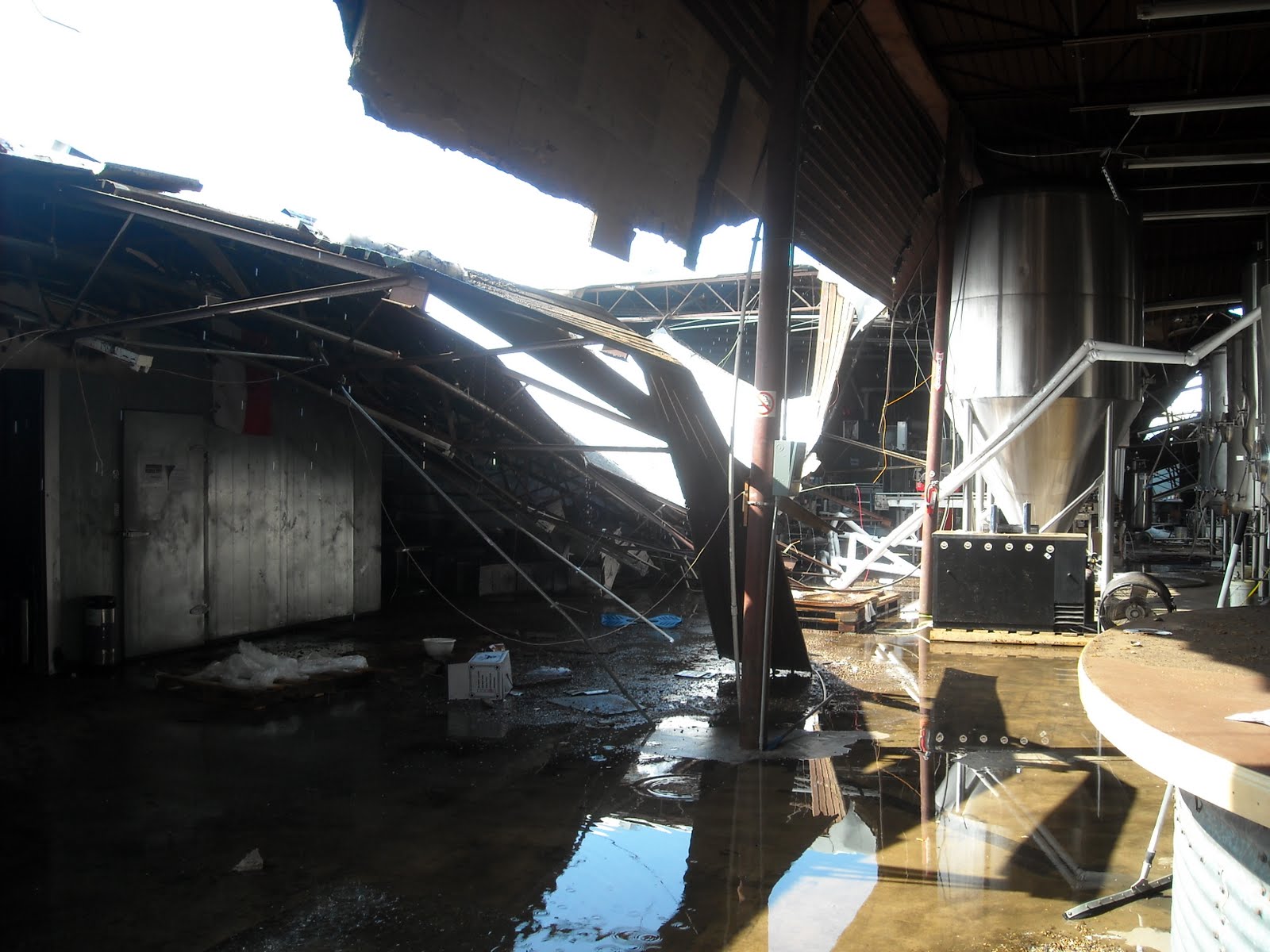
On February 12th, 2010, Fort Worth’s Rahr & Sons Brewery became the stuff of Texas legend by being the sole brewery in the history of the Lone Star State ever to be destroyed by a blizzard. Such events may be commonplace in northern climes but a record-setting 12.5-inch snowfall in just 24 hours is unheard of in North Texas, and unlikely to be repeated in our lifetimes.


The weight of the precipitation collapsed the roof of the brewery from stem to stern, busting a water main and plumbing and filling the warehouse operation just south of downtown with water a foot deep. Brewing and bottling equipment was ruined or partially crushed, and in some places the fermentors were the only structures holding up what remained of the snow-capped roof.

From an operational standpoint, the brewery was an almost total loss: Some equipment could be salvaged but it would be months before anything could be brewed again. Fortunately, insurance covered large portions of the damages, which meant that Rahr & Sons would definitely be brewing again at some future date. The only obstacle at this point was time.

But it was time put to surprisingly good and productive use. Coors Distributing arrived immediately and took what bottled product was left on-site for immediate sale. A few batches of beer remained in the unpowered conditioning tanks for weeks before they could be accessed and kegged, with the good fortune of mild weather keeping them fresh (and the unintended extra lagering time produced what was probably their best batch ever).

Fritz Rahr may have been a man without a brewery but he and his bunch were far from idle. Without the very popular Saturday tours and tastings every week, the Rahr brewing team moved out into the city of Fort Worth and the greater Metroplex, holding special events and tastings almost weekly as they kept the company name alive despite having no new beer. Even as bottles became more difficult to find on retail shelves, a series of sly viral videos featuring indolent brewers trying to amuse themselves attracted some minor national attention for this non-brewing brewery.

But as of this past June, Rahr & Sons became an actual working brewery once again. A new roof was installed and the entire facility replumbed, taking advantage of this reboot to reorganize some lines and equipment that were otherwise placed for expansion’s convenience. A new brew kettle and subsequent arrangement now cuts a 12- or 18-hour brewing cycle down to about six hours. A new bottling line will allow both 12-ounce and 22-ounce bottles, and the annoying and unreliable screw-caps are now history.

A new cold room has been added, including a temperature-controlled area specifically for barrel-aging beers. A new bar has been installed, making more space available for the inevitable crowds of fans who will soon fill this brewery on weekends. Even the bottle labels have been updated and standardized, with a modern and uniform style for all the beers produced.

Having his brewery destroyed may yet be the best thing to ever happen for Rahr & Sons, as it allowed them to tweak, subtly improve and redesign what had previously grown organically and haphazardly. With added capacity and more control over the brewing process, look for Rahr beers to significantly improve in quality. An entire barrel-aging program of beers is planned, some to be bottled and others exclusively local.

Rahr & Sons has finally turned the big corner, and anxiously awaits the city-issued certificate of occupancy before resuming their ever-popular Saturday tours. A business pairing with a contract brewing opportunity out-of-state will see the production of an entire line of sub-products under the Ass Kisser Ales label. And with their current setup and operations, they are poised to be a close contender for the second-largest craft brewery in the state behind Saint Arnold.

Sunday, May 30, 2010

The Dancing Bear Pub and a Beer Fest

Located in the most unlikely of spots possible is one of the best beer-focused pubs in the state of Texas, The Dancing Bear Pub. On a corner sharing a small freestanding building with a sandwich and pizza shop in Waco, this establishment has found a way to thrive amid both the Southern Baptists and the swilling college students mere blocks away at Baylor University.

Last week, The Dancing Bear Pub dared to host their first annual Texas Craft Brewers Festival in the lot just behind the pub. It was a small and almost local affair, far from the last state-wide event of the same name held in Austin back in 2003–2005. Only a handful of Texas brewers were represented but, in light of nothing equivalent elsewhere, it was a good start to a much needed tradition in this state.

Established in 2006, The Dancing Bear Pub is a true craft beer house. The interior has plenty of room to sit and socialize, with only a tiny bar at the end beneath the single television. Just 16 taps line the wall, which is close to an optimum number for serving beer at its highest quality and allowing selections to change frequently. Likewise with the bottle selection, featuring daily specials throughout the week intended to keep the stock always moving.

Owner and Waco native Paxton Dove is the one responsible for creating this oasis of a beer bar within a college-town environment—which is not always easy. Dove is not only a fan of craft beer, he is a seasoned homebrewer and organizer of a couple of central Texas homebrew clubs. He also has plenty of friends and contacts within the commercial brewing industry at both ends of I-35 and across the country.

In fact, Dove has his eyes on eventually converting to a brewpub model and brewing commercially through his place in Waco. He even went so far as to acquire all the necessary state and federal licensing to brew on-site before a paperwork snafu as the ATF transitioned to the TTB threw cold water on that idea. Now, with proven beer recipes already selected, finances and space limitations have the brewpub idea currently on hold. A small (10-gallon) brewing system may be the next step with this idea.

Naturally, and with a competing event the same day just down the highway in Temple, this Texas Craft Brewers Festival did not reach the size or scope of the aforementioned Austin event. However, this allowed for the 5-oz sample pours to be a little more generous, hourly raffles to award pub and brewery swag, and lines for the beers and the terrific pizzas from the shop next door to be much shorter. A local animal rescue organization was sponsored by the pub, who in turn was helped by ESPN Radio giveaways.

With an army of new craft brewers amassing in Austin, Waco may seem an unlikely place to host an “official” Texas Craft Brewers Festival—or is it an even better locale for this event? Resurrecting the festival in Austin may see it dominated by the new local Austin brewers, possibly to the point of discouraging Texas brewers outside of Austin from participating. The central location, reduced costs and neutral ground of Waco may be an ideal spot to promote this event annually.

But the success of the Dancing Bear is in the environment that is created not only by Dove but also by his staff, all of whom are just as knowledgeable about the products they sell. A similar Oktoberfest event is held at the same spot each year, featuring food from Kuby’s in Dallas. This is not a bar; it is a true local pub—an important distinction, and one surprisingly in touch with the larger modern craft beer movement outside of this minor Texas town.

Saturday, January 30, 2010

Caveat Emptor and the Craft Beer Consumer

I recently picked up a bottle of BrewDog’s Dogma, a new imported beer from a Scottish craft brewer previously unrepresented in this area. My intent was to evaluate and properly review the beer contained within for a future article but a few tell-tale signs lead me to abandon such an attempt. As happens on occasion in the craft beer world, especially with the new and imported, I was in possession of a bad bottle.

BrewDog Ltd. is a very experimental, “American-style” microbrewery located in Fraserburgh, Scotland, with beers only newly arrived in the North Texas market. I use the term “American-style” because BrewDog differs from the standard European brewing industry—steeped in tradition and loyal to regional styles—and instead is daring and boundlessly nontraditional with their products. Only a couple of months ago, BrewDog made international news with the “world's strongest beer” at 32% ABV.

Dogma is an herb/spiced beer brewed with additions of guarana, poppy seeds, kola nut and Scottish heather honey. Sometimes one can form an expectation of the flavor of a beer before sampling, but this unique combination of ingredients proved a challenge. Based on the description, some sort of lightly spiced, nutty, slightly honey-sweet beverage should have been forthcoming.

Instead, the beer that poured from this bottle was flat and lifeless with a taste to match, somewhat of an ripe, tangy flavor and a slightly not-so-unpleasant element that just was not quite right. It did not exhibit any of the typical characteristics of an infected beer (such as obvious sourness or a green apple flavor) or of oxidation (such as a stale or cardboardy element) but something in the profile just did not add up.

Suspicious, I referenced a few online reviews of this same beer and found almost no correlation between other drinkers’ descriptions and the beverage before me. My guess is that I purchased an old or mistreated bottle—which will happen occasionally in each beer drinker’s career. Especially vulnerable are imports newly arrived on the Texas market, beers of unknown provenance that not only cross the oceans under dubious storage conditions but may also sit in state-side warehouses for months on end awaiting regulatory approval.

Texas is especially guilty of this problem. Commercial approval of new beers for sale in our state’s markets can be tediously lengthy and expensive, with delays ranging from disputes over alcoholic strength to stylistic classifications to minor elements included on the labels. During this time, beers will sit—and where they sit and the environment in which they are kept is an unknown quantity.

Naturally, heat is an enemy of fresh beer and it is doubtful products are stored in the same sort of stifling warehouses as furniture, clothing or other environmentally durable goods. But imports (as well as many domestic brands) can suffer during transport periods without cooling controls, and even some areas of storage under air-conditioned units can be much warmer than intended, such as shelves stacked high off the ground.

One obvious sign of mishandling is a thick layer of sediment caked at the bottom of a bottle. Upon disturbing the beer, the detritus floats in suspension and can leave an otherwise delicious beer rather unappetizing, almost like a glass full of dietary fiber supplement. This is a positive indication that the beer has been through relatively rough temperature ranges, causing solids and proteins to fall out of their normal suspension.

The lesson here is that there is an unwritten element to evaluating craft beers, and that is to always consider the possibility of a mishandled or old bottle. Rare circumstances such as this should not reflect negatively on a brewer, and are most often remedied once distribution channels are established and refreshed regularly. Bringing such matters to the attention of your retailer is also a good idea, as they should also benefit from as much feedback as you can provide.

Sunday, January 10, 2010

Beers Texas Needs

In case you had not noticed, the young Texas craft beer market is currently flourishing. We are seeing an unprecedented number of national brands and imports arriving almost weekly, and our in-state commercial brewers are the strongest they have been since the reckless microbrew expansion of the dot-com era.

Naturally, all the stylistic basics seem to be covered. Amber ales and Vienna-style lagers are quite popular and widespread, as are many variations of the well-liked wheat or weizen styles. We have plenty of quality helles lagers, and fall brings an abundance of new Oktoberfest beers each year. We have a couple of decent IPAs (although we could always use more) and a few great stouts, albeit with the latter not truly in high demand with our grueling Texas summers.

So where do we go from here? What direction should Texas brewers take with their products, and which will prove the most successful? What gaps remain to be filled? The good news is that many market niches have already been identified and satisfied most profitably. We have schwarzbiers and Dortmunders and variations on the kölsch, all of which are great additions to our landscape. But we have still missed a few of the obvious.

Bock. The historical settlement of Central Texas is one of German and Czech immigrants, imparting a long and noble history of Germanic brewing to the Lone Star State. Yet too few breweries today embrace this heritage, particularly with respect to bocks and their subcategories. We do have maibocks and limited spring seasonals, but it seems craft brewers are content to relinquish the bock style to Spoetzl (even though Shiner is no longer categorized as a bock) when instead this state should have a market flooded with bocks from every brewhaus. And a popular state-brewed doppelbock is long overdue.

Münich dunkel. The dunkel, a slightly darker, roastier cousin of the Vienna lager, would make a fine competitor for either the dark, sweet lager that is now Shiner or as an alternative to brewing a true bock-style beer. Unfortunately, the only dunkels to be found in Texas are either imported from Germany or from Mexico, which has embraced its German and Austrian brewing heritage better than Texas has.

Berliner weisse. To brew a Berliner weisse for the scorching Texas heat should not even be debated. This low-alcohol wheat beer brings a refreshing lemon and citrus lactic tang to the traditional weizen already popular in hot weather. The proven success of hefeweizen and witbier in our state should prompt local craft brewers to explore all the variations of the weizen styles.

Rauchbier. Another seemingly obvious choice is the rauchbier, a German lager similar to a bock that is brewed with smoked malt and often with an addition of rye. The smoky flavor can be anywhere from subtle campfire to full bacon-flavored beverage, and its obvious pairing with native Texas barbecue should make it a commercial success if only for cooks building their marinades.

Czech pilsner. Despite being the most numerous commercial beer style on the market today, pilsners have drifted too far away from their authentic Bohemian origins. Instead of being smooth, sweet and forgettable, true Czech pilsners can be hopped as strongly as American IPAs using Saaz and other noble hops yet can remain equally as refreshing as a tame marketable lager.

Eisbock. Including an eisbock on this list is a guilty indulgence on my part but still one that may be economically competitive. A traditional strong bock is brewed and then held below freezing for a duration, after which the frozen water content is physically removed as ice (ethanol has a much lower freezing point than water). What remains is a high-gravity commercial competitor to barleywines and imperial stouts that is as smooth as schnapps and relatively unique to the marketplace.

Granted, a few of these styles have already been attempted by in-state brewers—even with ongoing success—but few remain as permanent products on the state’s large landscape. If existing and future brewers adopted German styles more, perhaps a unique national identity could successfully arise for Texas craft brewing.

Sunday, December 13, 2009

Divine Opportunity Missed

Just this past December 1st, Houston’s Saint Arnold Brewing Company released the latest edition of its specialty beer series, this one sequentially dubbed the Divine Reserve No. 9. In a departure from previous versions of classic high-gravity styles, the No. 9 is a unique recipe of an “imperial pumpkin stout,” a Russian imperial stout brewed with pumpkin and traditional spices.


Saint Arnold has been brewing this rather irregular series since 2005. Even-numbered releases are based on the winning recipe of the regional homebrew competition, the Big Batch Brew Bash, with odd-numbered versions being original in-house creations. In the past they have produced barleywines, imperial stouts and heavy IPAs; No. 9 has proven to be their most original attempt yet.

These Divine Reserve releases have grown into something of a frenzied cult following. Because the batch sizes are limited, unique and never to be reproduced, they often sell out statewide within days or even hours—or minutes, as is the case at some retailers. Demand is high both for consumption and for cellaring purposes, both by casual consumers and hard-core Saint Arnold fans alike.

Yet is Saint Arnold missing a prime marketing opportunity with this series? Limited editions are always a good profit engine for brewers but Saint Arnold seems to be mishandling some of the success that has fallen seemingly at its feet. Almost all the Divine Reserve beers are very highly rated individually but the series taken as a whole can be viewed as a lesser success.

To begin, there is the issue of the styles chosen. These include a couple of barleywines, a Belgian quadrupel, a strong IPA, a heavy Scotch ale (twice), a Russian imperial stout and a weizenbock. Granted that half the styles are dictated by the Big Batch Brew Bash, the choices made by the Saint Arnold brewers have not been the most original or experimental. Hopefully, the latest No. 9 is a break in this uncreative trend.

The second problem has been one of supply, most likely dictated simply by spare capacity at the brewery to hold one of these batches for the long term required. The extremely limited supply coupled with attempts to distribute throughout Texas means shortages in all places, and the accompanying media attention has lead to a growing following that ravenously purchase and hoard sizeable quantities as soon as each release hits the shelves. With any luck, expanded capacity at their new brewery location will ameliorate at least some of this issue.

However, the largest problem with this special series is also seemingly the easiest to remedy: timing. There appears to be no set schedule or calendar consideration for each Divine Reserve batch. A mere three months elapsed between releases No. 8 and No. 9, whereas the No. 8 came out almost a year after its predecessor. No perennial character exists, nor is there any attempt to correlate releases with seasons or calendar dates.

This problem of scheduling is a grand opportunity missed for a great deal of positive (and free) marketing and exposure. With an annual “Divine Reserve Day,” the media coverage would extend for months and consumers would plan their events with anticipation; instead, Saint Arnold fans are left racing against each other due to grass-roots notification via a mailing list. Cameras would capture the celebration surrounding this ersatz holiday (re: Three Floyds Dark Lord Day) instead of covering the frustrated crush at liquor stores on the day of release.

Will these matters be resolved with the expanded space and capacity at their newly occupied brewery just north of downtown? Possibly, at least those concerns related to space, capacity and distribution. As for criticisms of the choice of styles and release dates, this is a matter solely under the control of Saint Arnold management.